
A practical guide for Irish homeowners
What your BER tells you about your home
A Building Energy Rating (BER) indicates how energy efficient a property is. It helps homeowners, buyers and tenants compare the energy performance of homes and gives the owner an advisory report with recommendations for improvement.
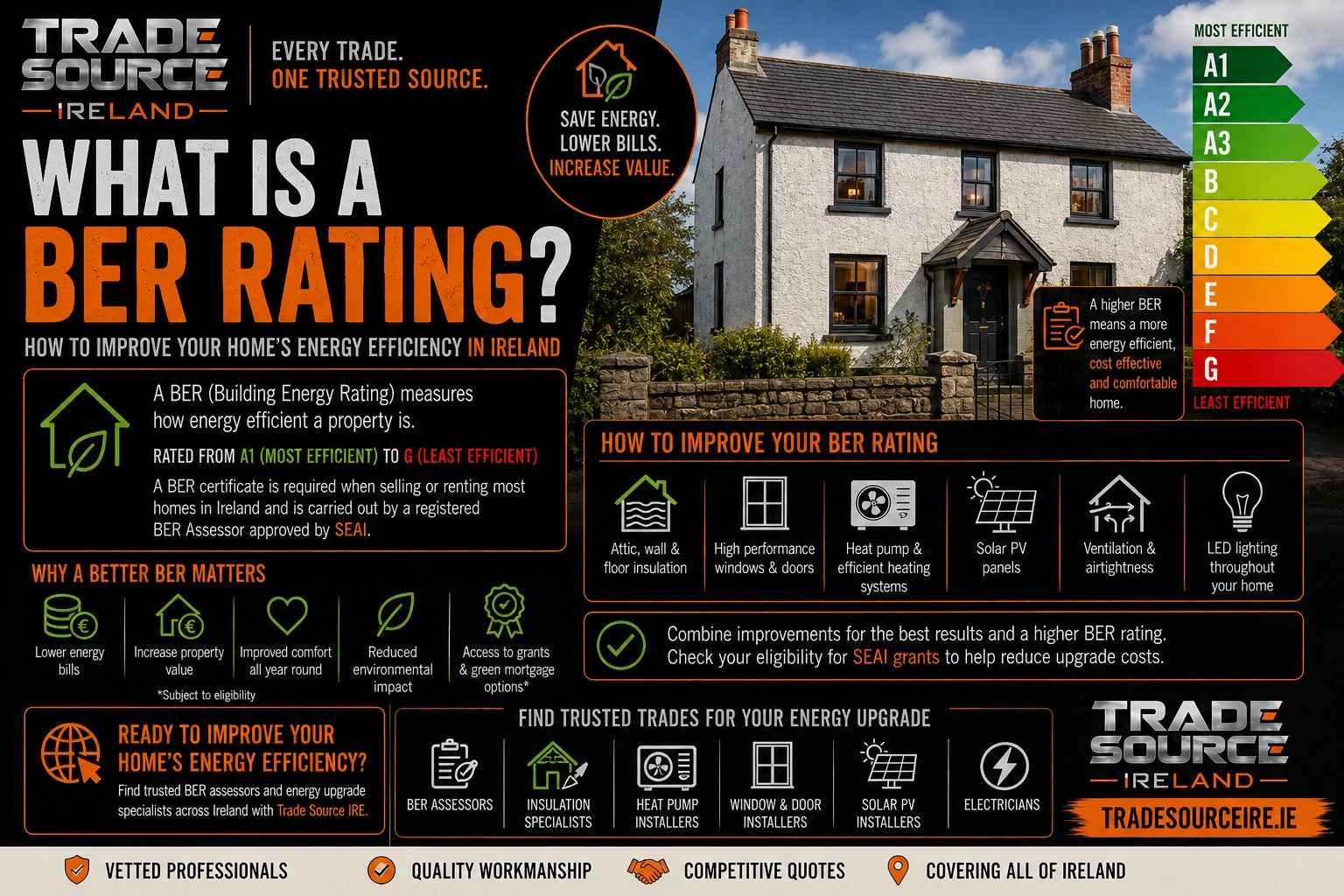
What is a BER rating?
A BER is the standard Irish rating for a building's energy performance. Under the current system, new BER certificates are rated from A0 to G. SEAI describes A0-rated homes as the most energy efficient homes that do not use fossil fuels.
BER certificates and advisory reports are generally required when buildings are constructed, sold or rented, although SEAI lists specific exemptions. The owner or landlord is responsible for obtaining the BER where it is required.
How to improve your BER rating
SEAI recommends planning upgrades so each stage builds on the work already completed. For many homes, that means improving the building fabric first, then the heating system, before adding suitable renewable technologies.
Attic, wall & floor insulation
Reducing heat loss is a key first step. Better insulation can improve comfort and lower the amount of energy needed to keep the home warm.
Find insulation contractors →Windows & doors
High-performance glazing and well-fitted doors can reduce draughts and heat loss, particularly when they form part of a wider fabric upgrade.
Browse suitable trades →Efficient heating & heat pumps
Once heat loss is low, an efficient heating system can improve energy performance. Heat pumps should be properly designed for the property's heat-loss level.
Find heating and plumbing trades →Solar PV panels
Solar PV can generate renewable electricity at home and can contribute to a better overall energy-performance profile when correctly specified and installed.
Read the Solar Panels Ireland 2026 guide →Ventilation & airtightness
Energy upgrades need an appropriate ventilation strategy. Improve airtightness carefully and seek professional advice so indoor air quality is protected.
Read SEAI's BER improvement guide →Efficient lighting
Replacing inefficient lighting with suitable LED lighting is a simple measure that can reduce electricity use and support better household efficiency.
Find an electrician →Use your BER advisory report as a roadmap
A BER certificate is accompanied by an advisory report. SEAI recommends using that report, together with advice from your BER assessor and other qualified professionals, to decide which upgrades are appropriate and in what order.
- Check your current BER.Find your certificate and advisory report, or arrange an assessment with a registered BER assessor.
- Prioritise heat loss.Review attic, wall and floor insulation, draughts, windows, doors and ventilation before choosing a new heating system.
- Plan the heating upgrade.Choose a system that suits the improved property and obtain a proper technical assessment before installing a heat pump.
- Consider renewables.Once the fabric and heating strategy are clear, review solar PV or other suitable renewable-energy measures.
- Check grants before work starts.SEAI states that grant approval must be in place before grant-supported works begin.
Why a better BER matters
Comfort, efficiency and a stronger home-upgrade plan
SEAI says improving a BER can increase a home's comfort, value and energy efficiency while reducing energy bills and carbon emissions. A better-performing home can also be more attractive when selling, and some finance or grant products may have their own BER-related eligibility criteria.
- Lower energy use
- Improved year-round comfort
- Reduced carbon emissions
- A clearer upgrade roadmap
- Potential property-value benefit
- Potential access to eligible grant or green-finance options
Find trusted BER and energy-upgrade specialists
Trade Source IRE helps homeowners across Ireland submit an enquiry for the professionals their project may need. Depending on the job, that could include a BER assessor, insulation specialist, heat-pump installer, electrician, window installer, plumber or builder.
For the BER certificate itself, use a registered BER assessor. For grant-supported upgrade work, check the exact SEAI scheme rules and verify that any required contractor registration is current before work begins.
Planning an energy upgrade?
Tell us what work you need
Submit your project details and Trade Source IRE can help route your enquiry to potentially suitable trade professionals where available. Always independently check registration, insurance, qualifications, quotations and references before appointing anyone.
Submit your projectFrequently asked questions
What is a BER rating in Ireland?
A Building Energy Rating indicates a property's energy performance. New BERs issued since 24 May 2026 use SEAI's simplified A0-to-G scale.
Is A1 still the best BER rating?
For new BERs, no. SEAI's simplified scale introduced on 24 May 2026 includes A0 as the top rating. Older valid certificates can still use the previous A1/A2/A3-style bands.
Do I need a BER when selling or renting?
Generally, buildings that are sold or rented need a valid BER certificate and advisory report, but exemptions apply to certain types of buildings. Check SEAI's current sales and rental guidance for your property.
What upgrades usually improve a BER?
Common measures include insulation, efficient heating, heat pumps where suitable, solar PV, windows and doors, ventilation and airtightness improvements, and efficient lighting. The best combination depends on the home.
Can I get an SEAI grant to improve my BER?
SEAI offers home energy grants for eligible measures and households. Check the current scheme before work begins; SEAI says grant approval must be in place before grant-supported works start.
Information sources
This guide was reviewed against current SEAI information on 7 August 2026. BER rules, scales, grant schemes and technical guidance can change, so confirm the latest requirements directly with SEAI before making decisions.