
Solar electricity guide
A practical 2026 guide for Irish homeowners comparing solar-panel prices, grant support, potential savings and professional installation requirements.
You do not need Mediterranean sunshine to generate solar electricity.
Solar photovoltaic panels—better known as solar PV panels—use daylight rather than heat. They continue generating electricity on overcast Irish days, although output is naturally higher in direct sunlight.
SEAI estimates that a well-positioned 3 kW home solar system can generate around 2,600 kWh of electricity per year, equivalent to more than 40% of the typical annual electricity demand of an Irish home. Around 75% of annual solar production normally occurs between May and September.
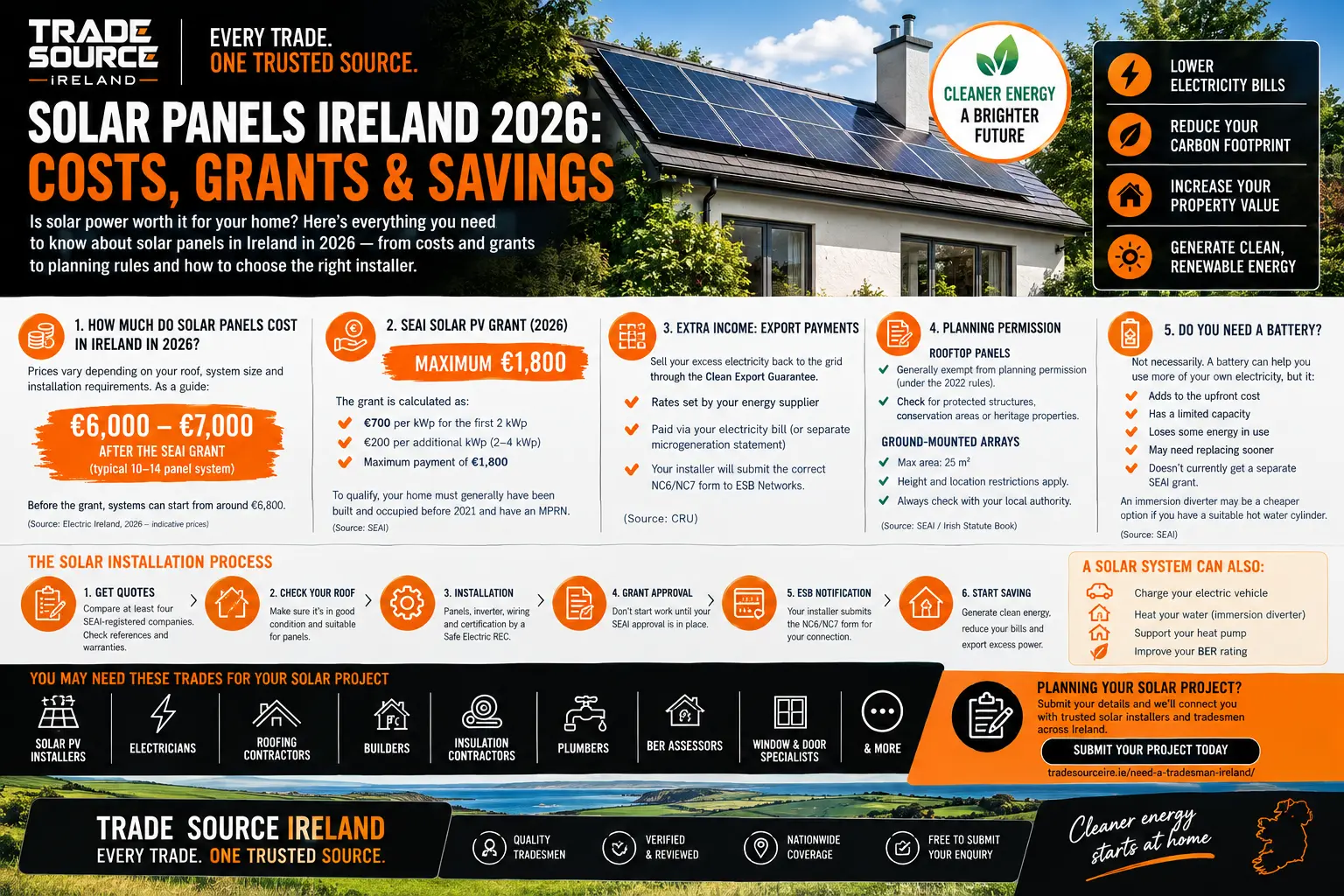
How Much Do Solar Panels Cost in Ireland in 2026?
There is no official national average because every roof and household is different.
As a current Irish market reference, Electric Ireland lists domestic solar installations from approximately €6,800 before the SEAI grant. Its August 2026 homeowner guide estimates that a typical 10-to-14-panel system may cost around €6,000–€7,000 after the grant, depending on the system and installation requirements. These are indicative market figures, not fixed prices.
The final quotation can be affected by:
- The number and output of the panels
- Roof size, pitch, orientation and condition
- Shading from chimneys, trees or neighbouring buildings
- Scaffolding and access
- Inverter type
- Cable routes and fuse-board condition
- Battery storage
- An immersion diverter
- Monitoring equipment
- Electrical or roof repairs required before installation
A cheaper quotation is not necessarily better. Compare the proposed annual generation, panel and inverter models, warranties, scaffolding, certification, grant administration and after-sales support—not simply the final figure.
What Is the SEAI Solar PV Grant for 2026?
2026 grant value
Maximum domestic Solar PV Grant: €1,800
- €700 per kWp for the first 2 kWp
- €200 per additional kWp from 2–4 kWp
- €1,600 for a qualifying 3 kWp system
- €1,800 maximum for 4 kWp or more
You may install a larger system, but the grant does not increase beyond the cap.
To qualify, your home generally must:
- Have an electricity MPRN
- Have been built and occupied before 2021
- Have no previous SEAI solar PV grant funding attached to that MPRN
- Use an SEAI-registered solar PV company
- Receive grant approval before work begins
- Complete the installation and required documentation within eight months
- Receive a post-installation BER assessment
For other available supports, read the Trade Source IRE SEAI Grants Ireland 2026 guide.
Is VAT Charged on Domestic Solar Panels?
The supply and installation of solar panels on or beside a private dwelling is currently subject to the 0% VAT rate where it forms one supply-and-install contract.
Ancillary equipment—including wiring, controllers and batteries—may also qualify for the zero rate when supplied and installed as part of the same solar-panel contract. A battery purchased separately at a later date may receive different VAT treatment, so ask the installer to show VAT clearly in the written quotation.
How Do Solar Panels Reduce Your Electricity Bill?
Solar electricity is most valuable when you use it directly in the house.
You may be able to increase your self-consumption by running suitable appliances during daylight hours, charging an electric vehicle, heating water through an immersion diverter or storing electricity in a battery.
A well-designed system should consider:
- Your previous electricity consumption
- Whether anybody is home during the day
- Current and future electric-vehicle charging
- A planned heat-pump installation
- Roof orientation and available space
- Your daytime and night-time electricity rates
A larger system is not automatically the most economical. The installer should provide an estimate of annual generation and explain how much electricity is likely to be used in the home and how much may be exported.
SEAI provides a solar electricity calculator that estimates potential savings and simple payback based on your county, roof direction, electricity price, system size and quotation. Savings are estimates, not guarantees.
Can You Sell Extra Solar Electricity to the Grid?
Yes. Under the Clean Export Guarantee, electricity suppliers pay eligible microgenerators for excess electricity exported to the national grid.
With a smart meter, exported units can be measured in half-hour intervals. The credit may appear on your normal electricity bill or on a separate microgeneration statement. Export rates are set by individual suppliers and can change, so compare the current payment rate alongside the supplier’s import tariffs and standing charges.
Your installation must be notified to ESB Networks:
- An NC6 form is generally used for microgeneration up to 6 kW on a single-phase connection or 11 kW on a three-phase connection.
- Larger installations of up to 50 kW generally use the NC7 process.
Confirm with the installer who will submit the correct form and keep a copy with your installation records.
Do You Need a Solar Battery?
Not necessarily.
A battery stores surplus daytime generation for use later in the evening or at night. It can increase the percentage of solar electricity used within the home and may also allow some households to charge at a lower night rate.
However, a battery:
- Increases the installation cost
- Has a limited usable capacity
- Loses some energy during charging and discharging
- May need replacement before the solar panels
- Does not currently attract a separate domestic SEAI battery grant
An immersion diverter may be a more affordable way to use surplus electricity where the property has a suitable hot-water cylinder. Ask for separate quotations showing the solar-only system, solar with a diverter and solar with battery storage.
Do Solar Panels Need Planning Permission?
For most ordinary Irish houses, rooftop solar panels can be installed without planning permission, subject to the detailed exempted-development conditions.
The previous domestic limit of 12 m² or 50% of the roof area has been removed, meaning qualifying panels can cover the available roof. However, extra checks may be required for:
- Protected structures
- Architectural Conservation Areas
- Heritage properties
- Special Areas of Conservation
- Installations that do not meet the roof-position conditions
- Properties affected by previous planning conditions
Free-standing ground-mounted arrays have separate limits. These include a maximum combined panel area of 25 m², height and location restrictions, and a requirement to retain sufficient private open space. Check the exact proposal with the local planning authority before signing a contract.
Read the Trade Source IRE Planning Permission Ireland 2026 guide for wider information on exempted development.
Check the Roof Before Installing Panels
Solar panels can produce electricity for 25 years or more, so installing them over a roof that already needs major repairs can create unnecessary future expense.
Before installation, check for:
- Broken or slipping slates and tiles
- Damaged felt or battens
- Leaks around chimneys and rooflights
- Weak or deteriorated roof timbers
- Poor previous repairs
- A roof covering that may need replacement soon
The mounting system must not compromise the roof’s weatherproofing. SEAI specifically warns against drilling directly through roof tiles in a way that could create future leaks.
Trade Source IRE can help you find roofing contractors across Ireland where repairs or an inspection are required. You can also review the 2026 roof-repair cost guide before budgeting.
Use Registered Solar and Electrical Professionals
To qualify for the grant, the work must be completed through an SEAI-registered solar PV company. SEAI recommends obtaining at least four quotations, checking references and having a written contract in place before proceeding.
The electrical connection must be completed by a Safe Electric Registered Electrical Contractor. A REC must work to the applicable national standards and provide the relevant electrical Completion Certificate.
Before signing, ask:
- Is the company currently registered with SEAI?
- Who is the named Safe Electric REC?
- What annual generation is predicted?
- What panel and inverter models are included?
- Are scaffolding, BER and grant administration included?
- Who submits the ESB Networks notification?
- What warranties apply to the panels, inverter and workmanship?
- Is there a monitoring app?
- What happens if the system underperforms or develops a fault?
- Is the quoted price before or after the grant?
Read why electrical work should be completed by a registered electrician and review electrician costs in Ireland for 2026.
How Trade Source IRE Can Help
A solar project may require a solar PV company, Registered Electrical Contractor, roofer, builder or BER assessor.
Trade Source IRE helps homeowners, landlords and businesses submit project enquiries for potentially suitable trade professionals across Ireland. Contractors applying to the network are reviewed before joining, but customers should still independently verify current SEAI registration, Safe Electric registration, insurance, references, quotations and warranties.
Useful Trade Source IRE links:
- Find electricians across Ireland
- Find roofing contractors
- Understand SEAI grants for 2026
- Learn how solar PV can improve your BER
- Explore other home-energy upgrades
- Submit your solar PV or roof project
Include your county or town, Eircode area, annual electricity consumption, roof direction, property type, current BER and whether you are considering a battery, immersion diverter, heat pump or EV charger.
Are Solar Panels Worth It in Ireland?
For many homes, yes—but only when the system is designed around the property and household.
Solar PV can reduce the electricity bought from the grid, provide export income, improve a BER and protect part of the household budget from future unit-price changes. Panels also have a long operating life and relatively low maintenance requirements.
The strongest results generally come from:
- A sound, largely unshaded roof
- A correctly sized system
- High daytime electricity use
- Sensible use of surplus generation
- A detailed quotation and realistic performance estimate
- Professional installation and certification
Do not buy based on panel count alone. Compare projected annual generation, total installed cost, grant eligibility, warranties and simple payback for your actual home.
Use the daylight. Cut your grid use. Get the system designed properly.
Every Trade. One Trusted Source.
Planning a solar project?
Get the right registered professionals involved.
Send your property location, roof details, electricity usage, preferred timeframe and whether you are considering a battery, diverter, heat pump or EV charger.
Frequently Asked Questions
Do solar panels work during an Irish winter?
Yes. Solar PV panels generate from daylight, including on overcast days. Output is lower in winter because the days are shorter and sunlight levels are reduced.
What is the maximum SEAI solar grant in 2026?
The current maximum domestic solar PV grant is €1,800, subject to eligibility and scheme conditions.
Does every home qualify for the grant?
No. The property generally must have been built and occupied before 2021, have an MPRN and have no previous SEAI solar PV funding attached to that MPRN.
Is a battery required?
No. A solar PV system can operate without a battery. Surplus electricity can be exported or directed towards hot water where suitable.
Will solar panels improve my BER?
Solar PV can contribute to improved energy performance and may strengthen the property’s BER. The final result depends on the complete building, heating system and other energy features.
Do I need a south-facing roof?
A south-facing, unshaded roof usually produces the highest annual output, but suitable east- and west-facing roofs can also perform effectively. The installer should model the expected production for the actual roof.
Irish Information Sources
- SEAI — Solar Electricity Grant
- SEAI — Homeowner’s Guide to Solar PV
- SEAI — Registered Solar PV Companies
- SEAI — Solar Electricity Calculator
- Revenue — VAT Treatment of Solar Panels
- CRU — Microgeneration and Export Payments
- CRU — Electrical Works in Your Home
- Irish Statute Book — Solar Planning Exemptions
- Electric Ireland — Current Solar PV Market Guide
Costs, export rates, grants and eligibility rules can change. This article provides general information rather than a quotation, financial guarantee, planning determination or technical system design. Verify current details with SEAI, ESB Networks, your local authority and appropriately registered professionals before committing to work.