
Anyone who built, extended or renovated a home in Ireland ten years ago will recognise one major difference in 2026: building materials cost substantially more.
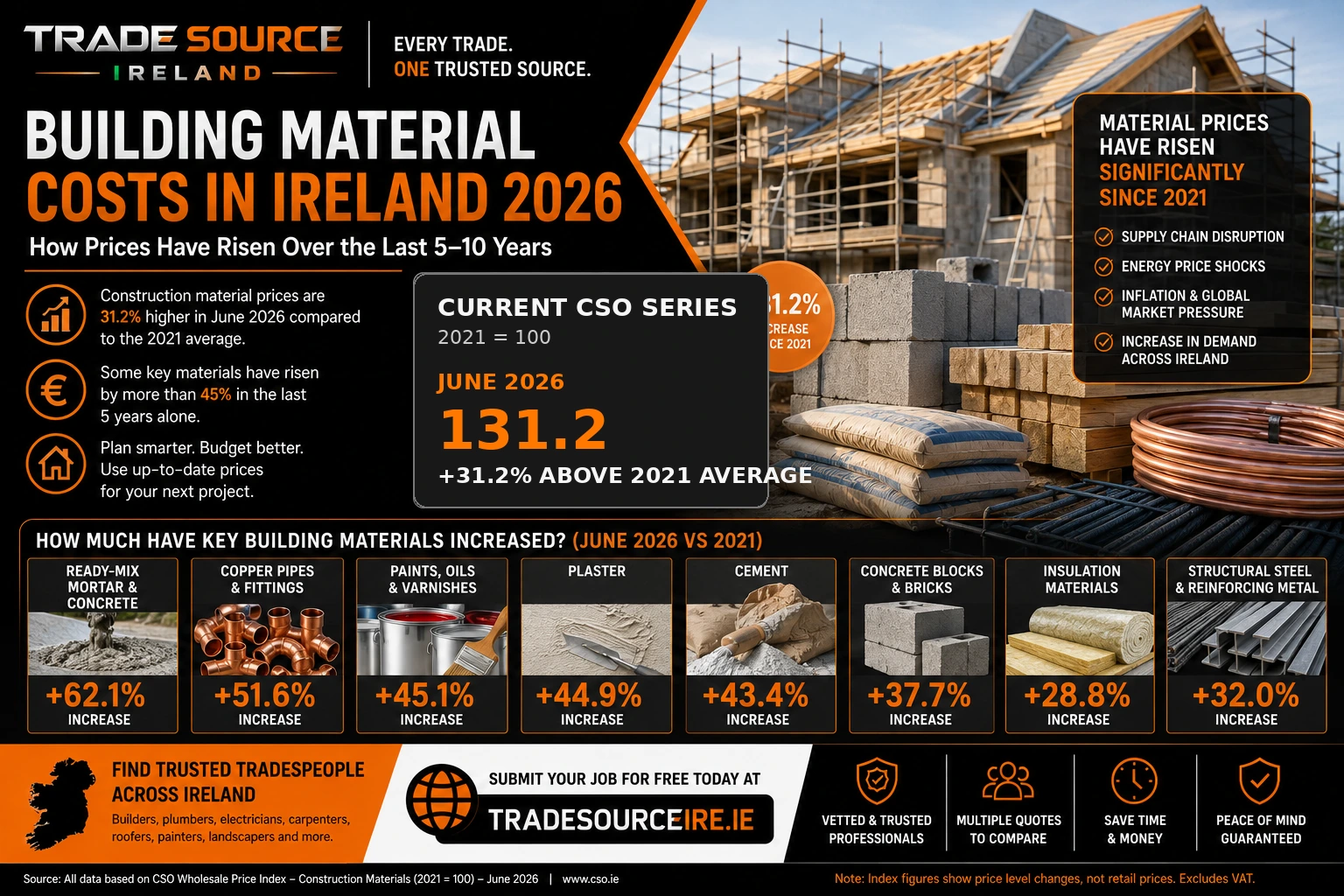
Historical CSO data shows the annual All Materials construction-price index at 101.4 in 2016 and 105.7 in 2018 on the old 2015=100 basis. The current CSO series has since been rebased to 2021=100 and puts the All Materials Index at 131.2 in June 2026.
Useful next step: View builders in Ireland, or find a tradesman in Ireland by trade or county.
For Irish homeowners, builders and developers, that higher cost base affects everything from a bathroom renovation and rewire to an extension or complete new build.
What building materials cost in Ireland in 2026
Rather than quoting one retail euro price - which can vary by merchant, brand, order quantity and county - the most consistent way to track the market is the CSO Wholesale Price Index for Building and Construction Materials. The June 2026 table uses a 2021 average of 100 and excludes VAT.
| Building material | June 2026 index | Change vs 2021 base |
|---|---|---|
| Ready-mix mortar & concrete | 162.1 | +62.1% |
| Copper pipes & fittings | 151.6 | +51.6% |
| Pipes & fittings overall | 149.6 | +49.6% |
| Other concrete products / precast | 147.2 | +47.2% |
| Sand & gravel | 146.4 | +46.4% |
| Paints, oils & varnishes | 145.1 | +45.1% |
| Plaster | 144.9 | +44.9% |
| PVC pipes & fittings | 143.4 | +43.4% |
| Cement | 143.4 | +43.4% |
| Concrete blocks & bricks | 137.7 | +37.7% |
| Stone | 136.6 | +36.6% |
| Structural steel & reinforcing metal | 132.0 | +32.0% |
| Insulation materials | 128.8 | +28.8% |
| Plumbing & sanitary ware | 126.2 | +26.2% |
| Glass | 116.0 | +16.0% |
| HVAC / heating & ventilation | 112.0 | +12.0% |
| Electrical fittings | 105.9 | +5.9% |
| All construction materials | 131.2 | +31.2% |
Source: CSO Wholesale Price Index, June 2026. These are index movements, not retail price quotations. An index of 145.1 means the indexed price level is 45.1% above the 2021 base.
The biggest increases have been hard to ignore
Some materials used on almost every Irish building project have seen especially large moves. Ready-mixed mortar and concrete is 62.1% above its 2021 base, while copper pipes and fittings are 51.6% higher. Paints, oils and varnishes are 45.1% above the base, plaster 44.9%, cement 43.4% and concrete blocks and bricks 37.7%.
Prices are also still moving in different directions. Between June 2025 and June 2026, the overall construction-products index rose 3.1%. Over the same year, ready-mixed mortar and concrete rose 8.7%, copper pipes and fittings 8.7%, paints, oils and varnishes 8.4%, and bituminous products 14.9%. Cement fell 5.3%, while electrical fittings fell 4.1%.
Do not assume every material moves together
Use current quotations
In June 2026 alone, paints rose 3.5% month on month, while insulation fell 4.9% and cement fell 4.8%. A current supplier or contractor quotation is far more useful than an old price found online.
How did we get here?
Before the pandemic, overall material inflation was comparatively moderate: the old CSO series moved from 100 in 2015 to 101.4 in 2016 and 105.7 in 2018.
The market then changed sharply. CSO analysis of the pandemic period found that between Q2 2019 and Q2 2021, rough timber prices rose 34.4%, structural steel and reinforcing metal 8.2%, electrical fittings 11%, and the All Materials measure 5.7%.
That was followed by energy-price shocks, global supply disruption and the wider economic effects of Russia's invasion of Ukraine. The SCSI says annual commercial construction tender-price inflation reached 11.5% in 2022.
Are building costs finally stabilising in 2026?
There are encouraging signs, but stabilising does not mean returning to old prices. SCSI reported annual commercial tender-price inflation of 2.5% in 2025, the lowest annual increase since 2020 and far below the 11.5% seen in 2022.
However, the CSO's combined Building & Construction Index - covering materials and wages - was still 3.2% higher in June 2026 than a year earlier. Ireland has moved into a more moderate inflation environment, but from a much higher overall cost base.
What this means for Irish homeowners
If you are planning a building project, house extension, bathroom renovation, kitchen renovation, attic conversion, plumbing work, electrical work, roofing or carpentry project in 2026, budgeting from what somebody paid five years ago can be misleading.
- Get several current written quotations
- Check whether labour, materials and VAT are clearly separated
- Ask what is included and excluded
- Confirm whether material-price changes can affect the final price
- Allow a sensible contingency for unforeseen work
- Compare scope and specification, not just the bottom-line figure
For project-specific context, you can also read our guides to house extension costs, plumbing and bathroom renovation costs, electrician costs and carpentry costs.
How Trade Source IRE can help
Whether you need a builder, plumber, electrician, carpenter, roofer, painter, landscaper or another skilled tradesperson, Trade Source IRE helps homeowners connect with potentially suitable local professionals.
With construction costs materially higher than they were five or ten years ago, comparing current quotes, project scope and credentials is more important than ever.
Every Trade. One Trusted Source.
Planning work on your home in 2026?
Tell us what you need, where the project is and the type of trade required.
Frequently asked questions
How much have construction material prices risen since 2021?
The CSO All Materials Index was 131.2 in June 2026 on a 2021=100 base, meaning the indexed construction-material basket was 31.2% above the 2021 average.
Which building materials have risen the most?
Among the June 2026 CSO categories, ready-mixed mortar and concrete was 62.1% above its 2021 base, copper pipes and fittings 51.6%, paints 45.1%, plaster 44.9% and cement 43.4%.
Are these figures retail prices?
No. They are CSO price indices excluding VAT. Retail and contractor prices vary by specification, merchant, quantity, location and project.
Are construction costs stabilising?
Inflation has slowed substantially from the 2021-2022 surge, but costs remain elevated. SCSI reported 2.5% commercial tender-price inflation for 2025, while the CSO Building & Construction Index was still 3.2% higher year on year in June 2026.
How should I budget for a project in 2026?
Use current written quotes, compare the same scope and specification, understand what is included for labour, materials and VAT, and keep a contingency for changes or unforeseen work.
Irish information sources
This article was reviewed against official CSO construction-material data and SCSI tender-price information on 9 August 2026.