
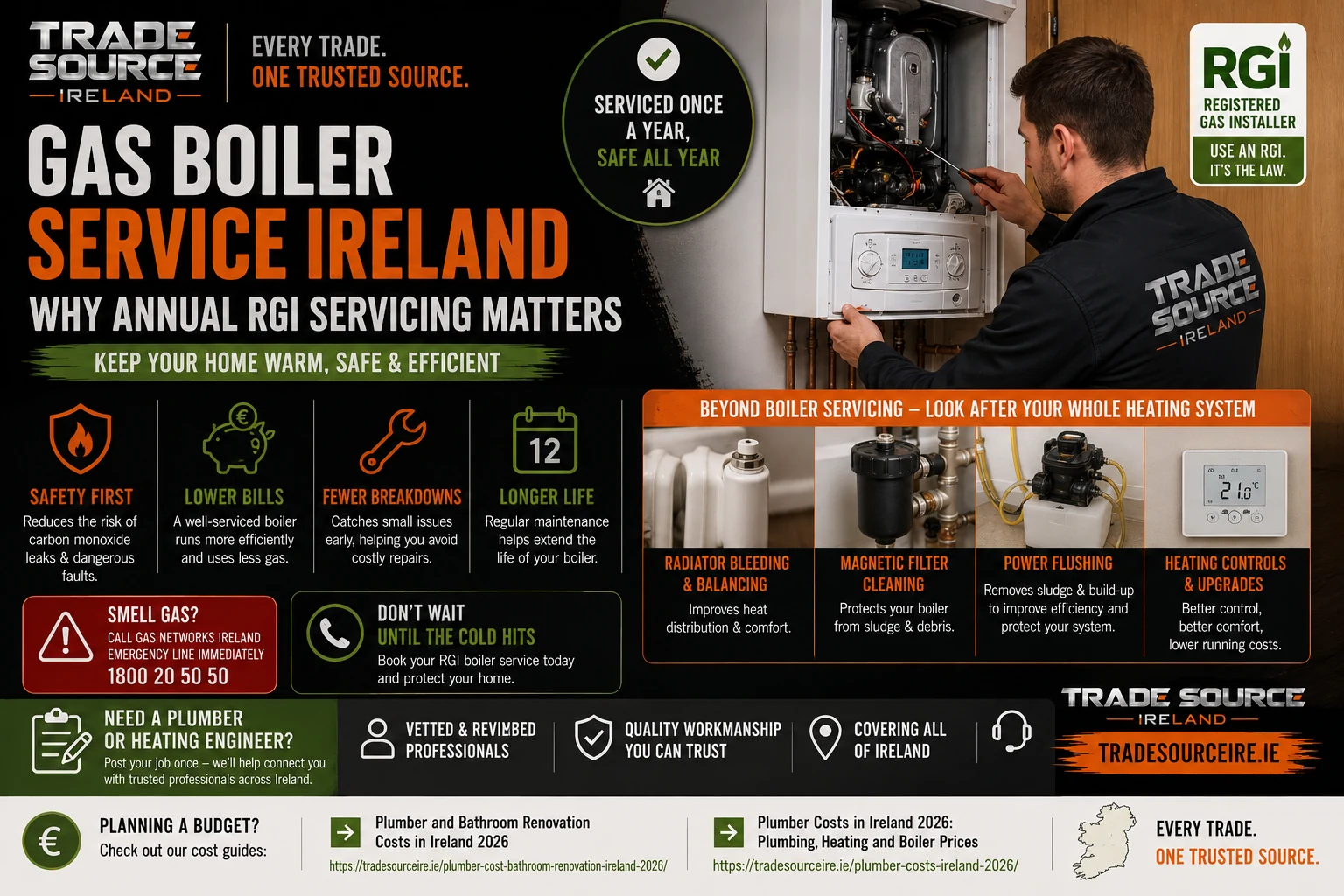
It is easy to put the boiler service on the long finger while the radiators are warm and the hot water is flowing. But when a boiler packs in during a cold snap, you could be left with no heating, no hot water and an expensive emergency repair.
A domestic gas boiler should be serviced once a year in line with the manufacturer's instructions. In Ireland, gas boiler servicing and repairs must be carried out by a current Registered Gas Installer (RGI). Not every plumber is qualified or legally permitted to work on gas, so always check the installer's RGI registration before work begins.
Gas safety
Use a current Registered Gas Installer
The RGI Scheme states that only a Registered Gas Installer may service a domestic gas boiler. Ask for the relevant Completion Certificate after the gas work is completed.
What Can Happen Without Regular Servicing?
Carbon-monoxide risks
Carbon monoxide is a poisonous gas that cannot be seen, smelled or tasted. A faulty appliance, blocked flue or ventilation problem can allow it to build up inside a home. Annual servicing helps the RGI check that the boiler is operating safely. A working carbon-monoxide alarm provides additional protection, but Gas Networks Ireland stresses that alarms are not a substitute for proper inspection and maintenance.
Higher heating bills
A boiler that is not operating correctly may use more gas than necessary. Regular servicing can help keep the appliance operating safely and efficiently and can identify issues before they become more serious.
Expensive breakdowns
Pressure problems, faulty controls, condensate issues and worn components can develop into larger faults. A service gives the RGI an opportunity to identify developing problems before the boiler stops working completely.
Reduced boiler life
Regular cleaning and maintenance can help protect important components and support the useful life of the appliance. Keep invoices, certificates and service records, particularly where a manufacturer's warranty has servicing conditions.
What Should a Boiler Service Include?
The exact checks depend on the boiler and manufacturer's instructions, but a gas boiler service may include:
- Boiler, burner and heat-exchanger inspection
- Flue and ventilation checks
- Gas-safety and combustion checks
- Condensate-pipe inspection
- System-pressure checks
- Thermostat, timer and heating-control testing
- Cleaning where required
- Identification of worn or faulty components
Ask the RGI what is included before booking. RGI guidance says servicing of gas appliances is covered by the certification system, with the appropriate certificate issued after the gas work is completed.
What Is Power Flushing?
Your boiler is only one part of the heating system. Over time, corrosion debris and sludge can build up in radiators, pipework and pumps. Where a heating professional diagnoses contamination, the system may need cleaning; a power flush is one method used to circulate cleaning fluid through the system and remove deposits.
Power flushing is not part of every annual boiler service, and it is not something every home automatically needs.
Possible signs of a dirty or poorly balanced heating system
- Radiators cold at the bottom
- Radiators taking a long time to heat
- Some rooms staying colder than others
- Noisy pipework or boiler operation
- Dirty water when radiators are drained
- Repeated circulation or pump problems
SEAI notes that a radiator that is cold at the top will often need bleeding, while a radiator that is cold at the bottom can indicate sludge and a system that needs cleaning. Uneven heating may also point to a need for balancing. Ask a heating professional to diagnose the cause before paying for a full power flush.
Do Not Forget Inhibitor and Magnetic Filters
After a heating system is cleaned, SEAI recommends adding central-heating inhibitor to help protect against future sludge build-up. A magnetic filter can also collect fine metal debris before it reaches the boiler, but it needs to be inspected and cleaned as part of normal maintenance.
Other useful heating-system services can include radiator balancing, pressure checks, heating-control upgrades, thermostatic radiator-valve replacement and magnetic-filter cleaning.
Find an RGI or Heating Professional with Trade Source IRE
Trade Source IRE helps homeowners, landlords and businesses submit plumbing and heating enquiries across Ireland. Whether you need a gas boiler service, boiler repair, radiator balancing, power flushing or an urgent heating call-out, send us the job once and let us help route the enquiry to potentially suitable tradespeople.
Customers should still independently confirm insurance, experience, qualifications, suitability and current RGI registration before appointing anyone for gas work.
Need boiler or heating work?
Tell us what you need and we will do the legwork
Include your county, boiler make and model, fuel type, last service date, any error code and whether you currently have heating and hot water.
Gas-Safety Warning
If you smell gas, call the Gas Networks Ireland 24-hour emergency line on 1800 20 50 50. Do not smoke, use a naked flame or operate electrical switches. Open doors and windows, move away from the suspected leak and make the call from a safe location.
Related Trade Source IRE Cost Guides
- Plumber and Bathroom Renovation Costs in Ireland 2026
- Plumber Costs in Ireland 2026: Plumbing, Heating & Bathroom Work
Do not wait until your boiler packs in. Service it annually, maintain the wider heating system and always use a current RGI for gas work.
Every Trade. One Trusted Source.
Official Irish information sources
Important note
This article provides general gas-boiler and heating-system information. It is not a substitute for inspection, diagnosis or gas work by a current Registered Gas Installer. If you smell gas, follow Gas Networks Ireland emergency advice immediately.