
Solar & Home Energy · 2026
Considering solar panels or a home battery? Learn about current Irish grants, 5kWh battery options, export payments, planning rules, VAT and professional installation requirements.
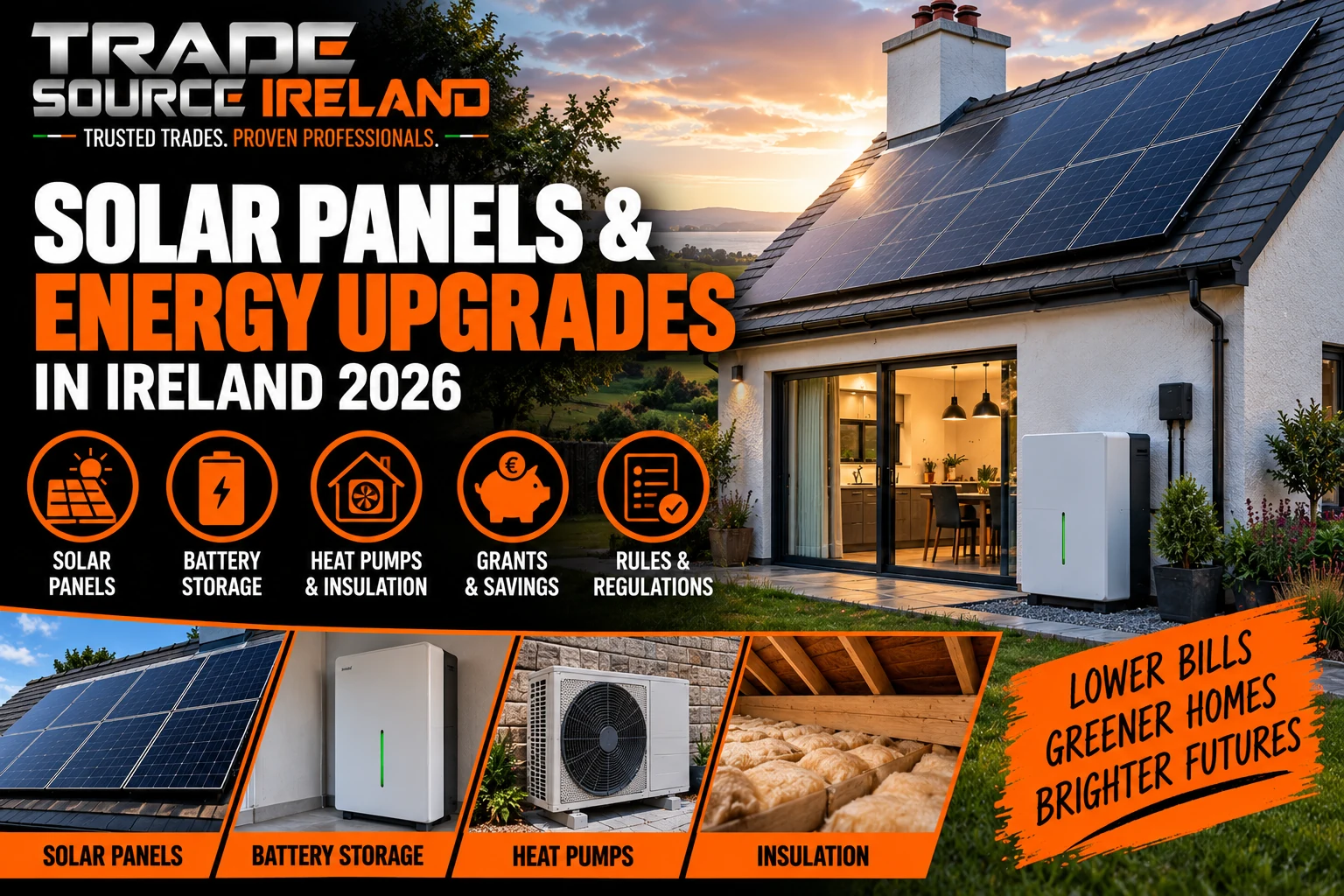
Solar panels are becoming an increasingly practical option for Irish homeowners who want to generate their own electricity, reduce the amount of power purchased from the grid and make better use of renewable energy.
Adding a home battery can take the system a step further by storing surplus daytime electricity for use during the evening or at night.
However, the right solar and battery system depends on your electricity use, roof, budget, tariff and future plans. A bigger system is not automatically a better investment.
Here is what Irish homeowners need to know about solar panels, battery-storage options, SEAI grants, planning rules, export payments and professional installation in 2026.
What Type of Solar System Can You Install?
Solar PV Without a Battery
A standard solar photovoltaic system generates electricity from daylight. Your home uses the solar electricity first, reducing the amount drawn from the national grid.
Any electricity that is not used immediately can be:
- Exported to the grid
- Directed towards a suitable hot-water cylinder
- Used to charge an electric vehicle
- Stored later if a compatible battery is added
This option can work particularly well where the household has significant daytime electricity use.
For current prices, system sizes and likely savings, read the Trade Source Ireland guide to solar panel costs in Ireland for 2026.
Solar PV With a Hot-Water Diverter
A solar diverter sends suitable surplus electricity to an immersion heater instead of exporting it immediately.
It can be a simpler alternative to a battery where the property has a suitable hot-water cylinder and regularly needs domestic hot water.
Solar PV With a 5kWh Battery
A battery stores surplus electricity generated during the day so it can be used later.
A 5kWh battery is currently the minimum size that qualifies for the new €600 SEAI Battery Energy Storage System Grant. The battery must meet the scheme’s technical conditions and be installed by an SEAI-registered solar PV contractor.
Larger or Modular Battery Systems
Homes with higher evening demand may consider larger or expandable battery systems.
This may be relevant where the household has:
- A heat pump
- An electric vehicle
- High evening electricity consumption
- A large solar-panel system
- Plans to add more panels later
- Several people working from home
- A time-of-use electricity tariff
Ask the installer to state the battery’s total capacity, usable capacity, maximum charge and discharge rate, expected warranty life and expansion options.
A 10kWh battery is not automatically twice as useful as a 5kWh battery. The correct size should reflect how much surplus solar electricity the home is likely to produce and how much electricity is normally used after sunset.
Solar Panel and Battery Grants in Ireland
The current standard SEAI support is:
| Upgrade | Current grant |
|---|---|
| First 2kWp of solar PV | €700 per kWp |
| Additional solar capacity from 2kWp to 4kWp | €200 per additional kWp |
| Maximum standard Solar PV Grant | €1,800 |
| Battery of 5kWh or larger | €600 |
| Maximum combined standard support | €2,400 |
For example, an eligible 4kWp solar PV system can qualify for the maximum €1,800 solar grant. Adding an eligible battery of at least 5kWh can bring the total standard support to €2,400.
Enhanced Support of Up to €9,000
Higher support is now available to eligible homeowners receiving certain qualifying Department of Social Protection payments.
Under this enhanced route, eligible applicants may receive:
- Up to €8,400 for a qualifying solar PV installation
- A further €600 for an eligible battery
- Maximum combined support of €9,000
A separate enhanced arrangement is also available for qualifying Dublin properties with long-term tenants receiving Rental Accommodation Scheme support through one of the four Dublin local authorities. Confirm the exact application process directly with SEAI or the relevant local authority.
Who Can Apply for the Standard Grant?
The current SEAI conditions state that:
- The property must have an electricity MPRN
- The home must have been built and occupied before 2025
- The MPRN must not already have received funding for the same solar or battery measure
- An SEAI-registered solar PV company must be used
- The applicant must receive a Grant Offer before work begins
- The approved work must normally be completed within eight months
- Solar PV applicants must arrange a post-works BER assessment
- The required electrical, commissioning and ESB Networks documentation must be submitted
Solar PV companies are also responsible for arranging the relevant ESB Networks notification and uploading the completion documentation required by SEAI.
Do not allow grant-supported work to start before the SEAI Grant Offer has been issued. Starting early can make the project ineligible.
For wider information on insulation, heat pumps, windows, doors and other support, read the Trade Source Ireland SEAI Grants Ireland 2026 guide.
What Are the Benefits of Battery Storage?
Use More of Your Own Electricity
Without a battery, electricity generated but not used during the day is normally exported.
A battery allows some of that surplus to be stored and used when the panels are producing little or no electricity.
Reduce Evening Grid Use
Many households use the most electricity in the evening, when cooking, lighting, televisions and appliances are all operating.
Stored solar electricity can reduce the amount purchased from the grid during those periods.
Combine Solar With a Heat Pump or EV
Solar panels, battery storage, electric vehicles and heat pumps can be managed together as part of a wider home-energy system.
SEAI advises that shifting electricity use towards periods of strong solar generation can improve the amount of renewable electricity consumed within the property.
Explore how solar can form part of a larger upgrade in these Trade Source Ireland guides:
- Heat Pumps Ireland 2026
- Home Insulation and Retrofitting
- Home Energy Upgrades That Can Save Money
- How to Improve Your BER Rating
Is a Solar Battery Always Worth Buying?
Not necessarily.
A battery may be more attractive where:
- The home exports a large amount of electricity during the day
- Electricity use is concentrated in the evening
- The occupants are away during peak solar-production hours
- A heat pump or electric vehicle is being added
- The battery can be charged intelligently around the household tariff
- Backup capability is an important requirement
A solar-only system may still be a strong option where the home already uses a high proportion of its electricity during daylight hours.
Ask for separate written quotations for:
- Solar PV without a battery
- Solar PV with a hot-water diverter
- Solar PV with a 5kWh battery
- Solar PV with a larger or expandable battery
Compare the total installed price, expected annual generation, estimated self-consumption, export assumptions, battery warranty and realistic payback rather than choosing solely by panel count.
Will a Battery Work During a Power Cut?
Do not assume it will.
A normal grid-connected solar and battery system does not automatically provide household backup during an outage.
ESB Networks states that solar PV and batteries can be used as standby generation only where the system is specifically designed, installed and tested for island or off-grid operation by a Registered Electrical Contractor. Appropriate changeover and isolation equipment is also required.
Before ordering a battery, ask whether the quotation includes:
- No backup
- One or more essential backup circuits
- Whole-home backup
- Manual or automatic changeover
- The maximum power available during an outage
Backup capability is different from battery capacity. A battery may hold plenty of energy but still be unable to operate high-load appliances during an outage if the inverter and electrical design are not suitable.
Can You Sell Surplus Solar Electricity?
Yes.
Under Ireland’s Clean Export Guarantee, eligible microgenerators can receive payment from their electricity supplier for surplus renewable electricity exported to the grid.
The export payment rate is set by each supplier and can change. Homeowners should compare:
- The export rate
- The electricity import rate
- Standing charges
- Day and night rates
- Smart-tariff conditions
- Contract duration
Exported electricity normally appears as a credit on the electricity bill or on a separate microgeneration statement.
Using solar electricity directly in the home may deliver greater value than exporting it where the retail import price is higher than the export payment, but the best arrangement depends on the household tariff and consumption pattern.
ESB Networks Connection Rules
Solar PV and battery systems connected to the electricity network must be notified to ESB Networks.
The normal microgeneration limits are:
- Up to approximately 6kVA on a single-phase connection
- Up to approximately 11kVA on a three-phase connection
Systems within these limits generally follow the NC6 microgeneration process. Larger installations may require the NC7 mini-generation process and technical assessment before connection.
Confirm with the installer:
- Which ESB Networks process applies
- Who submits the application
- Whether the inverter is approved
- Whether export limiting is required
- When connection approval is expected
- What records you will receive after completion
Do Solar Panels Need Planning Permission?
Most rooftop solar-panel systems on ordinary houses can be installed as exempted development, provided all relevant conditions are met.
The previous domestic rooftop area restriction has been removed, meaning there is currently no general rooftop panel-area limit for houses.
However, additional checks may be required where the property is:
- A protected structure
- Within an Architectural Conservation Area
- Subject to an existing planning condition
- A heritage property
- Using a free-standing or ground-mounted array
- Likely to create a public-safety issue through glint or glare
Where there is any doubt, contact the local planning authority before entering into a contract.
Is There VAT on Solar Panels and Batteries?
The supply and installation of solar panels on or adjacent to a private dwelling currently qualifies for the 0% VAT rate when supplied as a qualifying supply-and-install contract.
Revenue guidance also states that ancillary equipment—including wiring, controllers and batteries—can qualify for the zero rate where it is supplied and installed with the solar panels under the same contract.
Where a battery is purchased separately or added later, ask the supplier to confirm the correct VAT treatment for that specific arrangement.
Use Registered Solar and Electrical Professionals
For an SEAI-supported project, the solar PV company must be registered for the relevant scheme.
The electrical work must be carried out and certified by a Safe Electric Registered Electrical Contractor. Irish electrical-safety rules require domestic electrical contractors to hold the appropriate registration, and the customer should receive a Completion Certificate for the completed electrical work.
Before signing a contract, confirm:
- Current SEAI company registration
- Safe Electric registration
- Public-liability insurance
- Panel and inverter models
- Battery make, model and usable capacity
- Product and workmanship warranties
- Estimated annual electricity generation
- Roof condition and mounting method
- BER responsibility
- ESB Networks notification
- Whether scaffolding is included
- Whether backup power is included
- Total price before and after grant support
- Deposit and stage-payment terms
- Expected completion and certification documents
SEAI states that registration does not mean it approves, guarantees or warranties a contractor or their work. Homeowners must still compare quotations, check references and agree the scope in writing.
How Trade Source Ireland Can Help
A solar and battery project may involve more than one trade. Depending on the property, you may need a solar PV company, Registered Electrical Contractor, roofer, BER assessor, insulation contractor, plumber or heating specialist.
Trade Source Ireland helps homeowners, landlords and businesses submit project enquiries and route them towards potentially suitable independent professionals where available.
Useful links:
- Request a Tradesman
- Find Electricians Across Ireland
- Find Roofing Contractors
- View All Trade Categories
- Tradesmen Showcase
- How Trade Source Ireland Checks Contractors
It is free to submit an enquiry, with no obligation to proceed. Customers should still independently confirm registration, insurance, qualifications, quotations and suitability before appointing anyone.
Are Solar Panels and Batteries Worth It in Ireland?
For many homes, solar PV can be a worthwhile long-term energy upgrade—but the system must be designed around the actual property and household.
The strongest projects usually have:
- A sound and reasonably unshaded roof
- A system sized around real electricity use
- A realistic generation estimate
- A clear plan for surplus electricity
- Suitable grant approval
- Proper electrical certification
- Strong product and workmanship warranties
- A fair comparison between solar-only and battery options
Generate electricity during the day. Store it for later. Export what you do not need.
Every Trade. One Trusted Source.
Official Irish Information Sources
Information checked on 8 October 2026. Grant schemes, supplier payments and technical rules can change, so confirm the current position before beginning work.
- SEAI — Solar Electricity Grant
- SEAI — Battery Energy Storage System Grant
- SEAI — A Homeowner’s Guide to Solar PV
- SEAI — Smart Energy Technologies
- ESB Networks — Microgeneration
- CRU — Microgeneration and Export Payments
- CRU — Electrical Works in Your Home
- Government of Ireland — Solar Planning Exemptions
- Revenue — Zero Rate of VAT
- Revenue — Detailed VAT Treatment of Solar Panels